IVRM operates through a structured institutional logic that links capability governance to realized value.
It provides a repeatable institutional operating mechanism for defining capabilities, assessing capability condition, monitoring capability signals, mapping dependencies, prioritizing interventions, reviewing the capability portfolio, and tracking value realization over time.
The formal non-optional baseline of valid IVRM is defined on the IVRM Minimum Demonstrable Package page. This page explains the operating logic through which that baseline functions in practice.
Core operating logic
IVRM is designed to function as a recurring institutional management mechanism rather than a one-time assessment method. Its operating logic connects capability definition, governance, assessment, monitoring, dependency interpretation, intervention prioritization, portfolio review, and value realization into one coherent management structure.
This operating logic can be understood in two complementary ways. First, IVRM can be viewed as a set of connected management components that must remain intact if capability governance is to support disciplined value realization. Second, it can be viewed as a recurring operating cycle through which those components function over time.
The component model below shows the major structural elements that IVRM brings together into one management logic. These are not separate activities to be performed independently. They form one connected institutional mechanism.
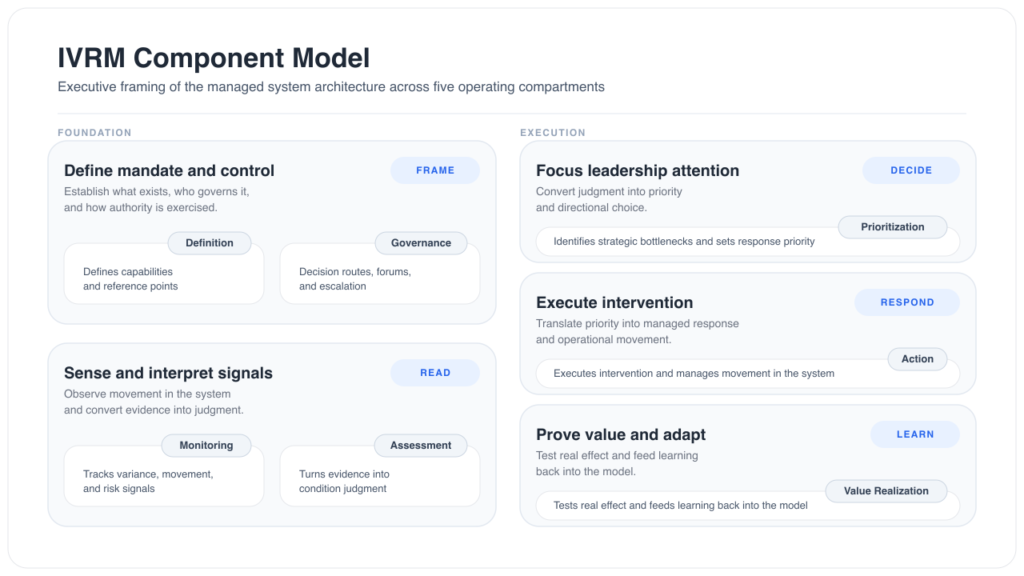
Seen this way, IVRM is not merely an assessment tool or a review framework. It is a connected management structure in which capability definition, governance, assessment, monitoring, dependency interpretation, prioritization, portfolio review, and value realization reinforce one another. If one element is missing, the institutional logic weakens.
Operating cycle
If the component model shows what IVRM consists of, the operating cycle shows how IVRM functions in practice over time. It translates the model from static structure into a recurring institutional management rhythm.
The cycle below illustrates the practical sequence through which institutions define capabilities, assess condition, monitor signals, interpret dependencies, prioritize interventions, review the portfolio, and track realized value.
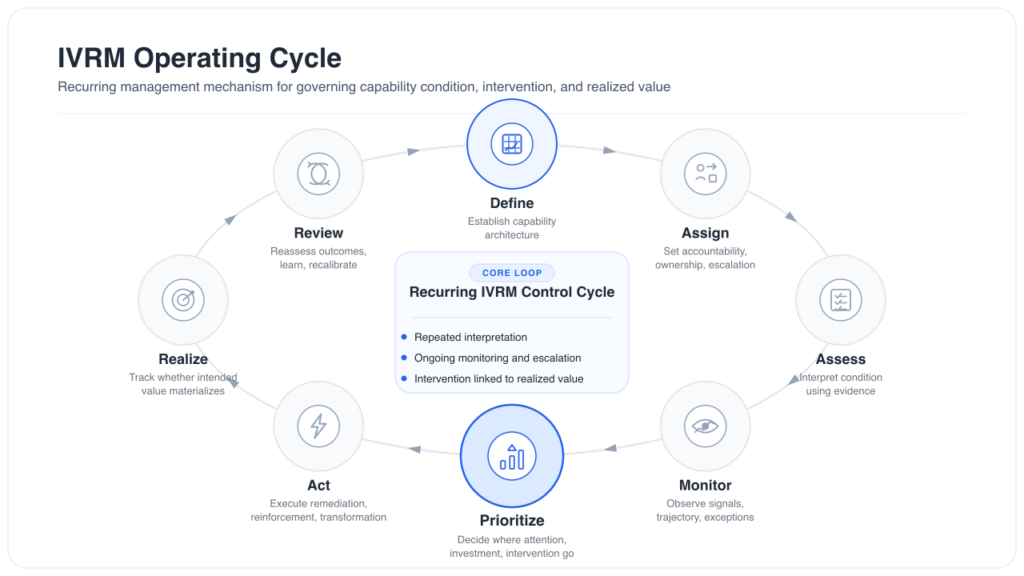
The IVRM operating cycle begins with capability definition and ownership because institutions must first establish what is being governed and who is accountable. From there, capability condition is assessed, signals are monitored, dependencies are interpreted, interventions are prioritized, and the portfolio is reviewed at leadership level.
Realized value is then tracked in relation to the action taken. The significance of the cycle lies not only in its sequence, but in its recurrence: IVRM is designed to function as an ongoing institutional mechanism rather than as a one-time exercise.
- Define capabilities and assign ownership
- Assess capability condition
- Monitor capability signals
- Map dependencies across capabilities
- Prioritize capability interventions
- Review the capability portfolio
- Track realized value
Review is not passive observation. In IVRM, review is the recurring governance process through which leadership interprets capability condition, dependencies, intervention posture, and value evidence in order to determine whether reassessment, reprioritization, or further action is required.
Capability definition and ownership
IVRM begins by establishing capabilities as governable institutional objects. Each capability must be defined clearly enough to support ownership, assessment, monitoring, intervention, and value-realization review. This requires explicit institutional accountability rather than loose association or project-style responsibility.
Assessment, indicators, and monitoring
Assessment interprets capability condition. Monitoring sustains visibility between formal assessment cycles. IVRM requires both. Assessment provides an evidence-based institutional judgment of capability condition, while monitoring provides ongoing signals that support review and reassessment over time.
Those signals should be interpreted through the IVRM Indicator Architecture, including capability condition indicators, value trajectory indicators, risk and control indicators, customer and market indicators, dependency indicators, and governance indicators. IVRM also requires confidence and evidence discipline so that weak evidence, proxy evidence, and uncertainty are governed explicitly rather than ignored.
Dependency mapping
Capabilities do not operate in isolation. IVRM maps material dependencies across the capability portfolio so institutions can understand where the condition, continuity, or effectiveness of one capability materially affects another. Dependency mapping supports portfolio review, intervention prioritization, and governance action.
Intervention prioritization
IVRM supports intervention prioritization by connecting capability condition, institutional importance, dependency structure, and exposure to action choice. This creates a governed basis for directing attention and resources with greater precision.
Portfolio review
Capabilities must be reviewed as a managed institutional portfolio rather than as disconnected operational issues. IVRM creates a leadership-level view of capability condition, dependencies, intervention posture, and institutional implications suitable for executive steering.
Value realization tracking
IVRM does not stop at intervention. It requires institutions to distinguish intended value from realized value and to track whether capability-related action has produced institutional effect over time. This is governed through the IVRM Value Realization Proof Standard, which keeps baseline, expected movement, indicators, timeframe, attribution logic, and variance review explicit.