Sector profiles translate IVRM into specific institutional contexts while preserving the integrity of the core standard.
IVRM is designed as a general institutional management standard with a stable core logic. Sector profiles provide the fixed sector-specific content through which the model is applied consistently within a given domain, without altering the core operating logic or the IVRM Minimum Demonstrable Package.
Purpose of sector profiles
Sector profiles exist to define the sector-specific content needed to apply IVRM coherently within a particular institutional environment. They translate the model into sector-relevant capability domains, governance patterns, monitoring signals, dependency structures, intervention priorities, and value-realization pathways while remaining consistent with the public standard.
What remains constant
The core definition of IVRM, its operating logic, and its minimum institutional chain remain constant across sectors. Sector profiles do not redefine the model. They apply the model within a sector-specific environment while preserving comparability, portability, and structural consistency.
- Core model definition
- Core operating logic
- IVRM Minimum Demonstrable Package
- Controlled vocabulary and semantic rules
- Institutional purpose of value-realization governance
What may vary by sector
What varies by sector is not the logic of IVRM but the content through which that logic is applied. Sector-specific variation may include capability domains, governance patterns, evidence environments, monitoring signals, dependency structures, intervention guidance, and common value-realization pathways.
- Capability domains and emphasis
- Governance context and ownership patterns
- Monitoring signals and evidence environments
- Dependency patterns
- Intervention priorities and posture guidance
- Value-realization pathways
Sector profile and institution-specific application
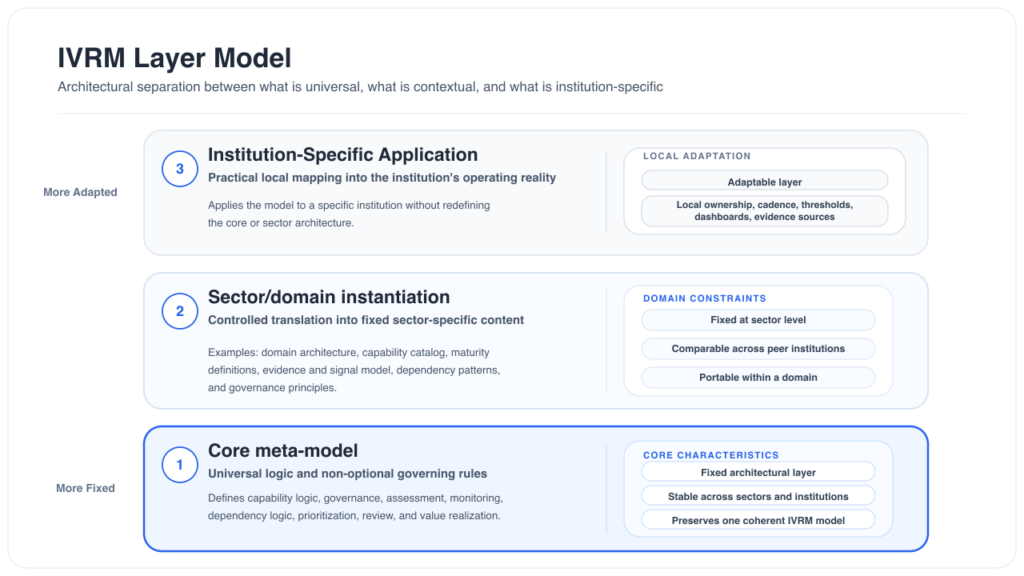
A sector profile is not the same as institution-specific application. The sector profile defines the stable sector content that should remain fixed across applications in a given domain. Institution-specific application maps that content into an organization’s actual structure, ownership model, reporting environment, and operating reality. This distinction allows IVRM to remain portable without becoming abstract or institutionally detached.
U.S. Banking
The IVRM U.S. Banking Sector Profile v1.0 is the current public sector profile. It defines the fixed banking-specific content through which IVRM is applied consistently across U.S. banking institutions and later mapped into each bank’s local operating reality.
It includes the banking domain architecture, sector capability content, governance patterns, signal and evidence model, dependency patterns, prioritization guidance, standard banking management views, and value-realization interpretation needed to apply IVRM coherently in a banking context.
Public reference boundary
Sector profiles are public reference publications. They define sector-specific interpretation and content boundaries, but they do not include institution-specific ownership assignments, thresholds, dashboards, implementation mechanics, or proprietary delivery controls.
Future profiles
Additional sector profiles may be published over time as IVRM is extended into other institutional environments. Future profiles will remain aligned to the same core model, core operating logic, controlled vocabulary, and IVRM Minimum Demonstrable Package so that sector expansion does not weaken the integrity of the public standard.